Politics
15k Ladakh-grown Liliums set out for national flower markets
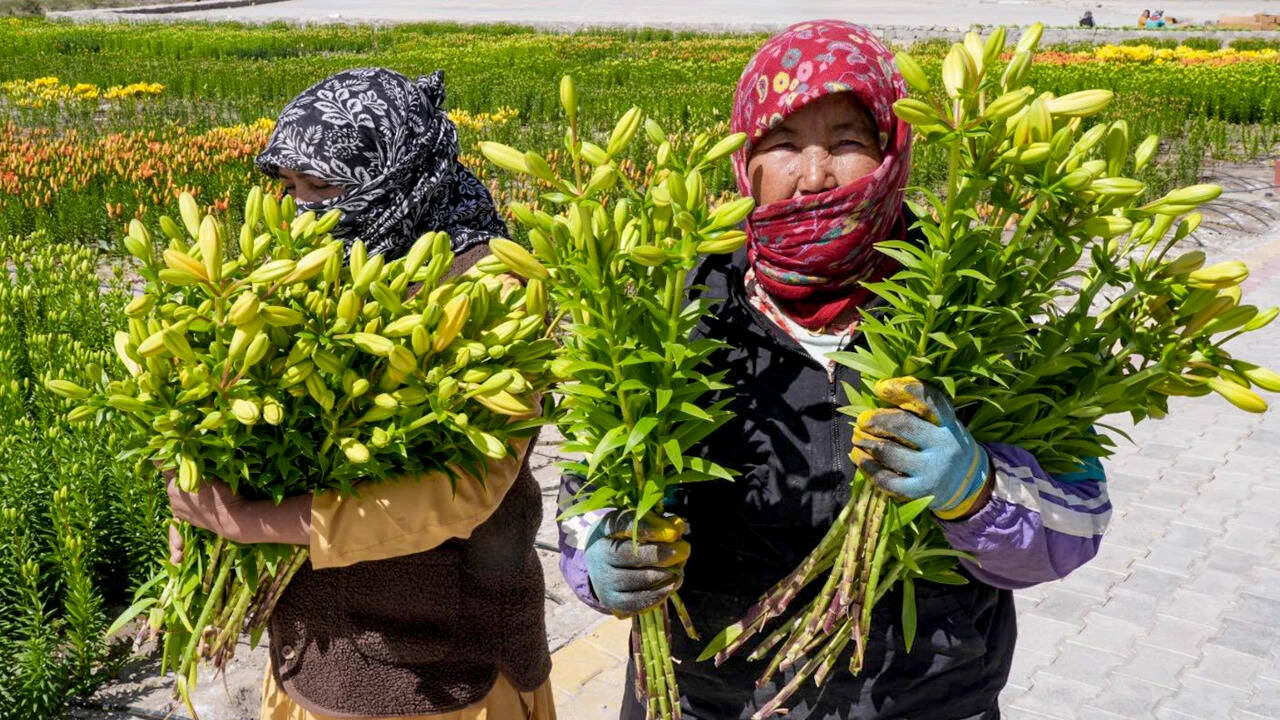
The consignment comprised 15,000 red, pink, white, and orange Lilium blooms cultivated at an altitude of 10,600ft at the world’s highest flower field at Choglamsar, Leh. SRINAGAR: The first consignment of Ladakh-grown Lilium flowers was dispatched to major flower markets in India on Tuesday, in what the Union Territory administration called a major step towards boosting new economic opportunities and entrepreneurship in the cold desert.The consignment comprised 15,000 red, pink, white, and orange Lilium blooms cultivated at an altitude of 10,600ft at the world’s highest flower field at Choglamsar, Leh. These “A-grade” Liliums have four to five buds on each stem and fetch a premium price of around Rs 150-200 in retail markets. The flowers, with a shelf life of five to seven days, will be sold in various domestic markets, primarily Delhi, Mumbai, and Chandigarh.Ladakh lieutenant governor Vinai Kumar Saxena, who flagged off the consignment at Leh airport, said: “This first-of-its-kind high-altitude commercial floriculture project in Ladakh represents a major agricultural and visual shift for the region, which has, since ages, been identified by its rugged mountains and barren valleys. Millions of Liliums have added a vibrant contrast to this dull landscape.” Join conversation View All Comments → Share your thoughts in the comments Insightful Agree Disagree Skeptical Concerning Promising Worth Reading Big Development Post Comment Be respectful · TOI community guidelines Saxena said the “historic” initiative had emerged as a powerful economic tool for creating alternative sustainable livelihoods in Ladakh. Fifteen women cut, sort and package the flowers at these fields for a daily wage of Rs 900 each. A young, qualified botanist markets the produce to flower markets across the nation. The employees are all locals.The UT administration has directed deputy commissioners of Kargil, Drass, Sham, Changthang and Zanskar districts to replicate the high-altitude floriculture model by identifying at least 20 acres of land in each district.The flower field in Leh, which houses more than 25 lakh blooms, was developed and readied within just two months. It was opened to the public on Sept 17 this year and has since received an overwhelming response from visitors.
Times of India·3 hours ago·2 min read
Politics
Democracy without choice: how unopposed Maharashtra rural polls silence dissent
Amid ongoing debates over the special intensive revision (SIR) drive by the Election Commission, name deletions, and electoral transparency, a quiet disenfranchisement persists at the grassroots level in Maharashtra -- where some local panchayats have not held elections for as long as 70 years. In these villages, the local leadership ensures that all members of the gram panchayat are chosen “unopposed”, bypassing the ballot box entirely.
In Angar town of Solapur district, a gram panchayat election hasn’t been held in 60 years. Even when the village was upgraded to a nagar panchayat last year due to population growth, leadership remained uncontested.
“We don’t have local elections; our people only vote for the Assembly and Lok Sabha. We have stood united for all these years, and people have faith in our family,” said former MLA Rajan Patil, whose family has controlled local politics for generations.
Over the decades, the politically versatile family has transitioned through the Congress, the Nationalist Congress Party, and currently, the BJP.
Succeeding his late father Baburao, Mr. Rajan Patil now shares political power with his sons, Ajinkya and Vikrant, while his daughter-in-law, Prajakta, was elected unopposed as the nagar panchayat’s first president last year.
However, the transition stirred controversy after opponents alleged that aspiring candidates were threatened and pressured not to run, accusations the Patils strongly deny.
This culture of unopposed elections has taken root in hundreds of villages across Maharashtra. Mr. Rajan Patil defends the practice, arguing that competitive elections divide communities, waste money, and hinder development.
A similar dynamic unfolds in Perid village in Kolhapur district. With a population of about 3,000, Perid has not held a contested gram panchayat election since 1956, leaving the local Patil family in charge.
“This is our tradition, where all villagers come together and decide who should be the member of the gram panchayat. In the last election, one person went against this tradition and an election was held for one of the nine seats, but he didn’t even turn up to vote,” says deputy sarpanch Shivaji Patil.
He added that this unopposed election culture extends beyond village politics to local milk societies and other cooperative bodies.
Explaining the origins of this culture, Mr. Shivaji Patil said that to prevent bitterness in village communities that arise from political feuds tearing apart families and social bonds, their forefathers decided to opt for this model of unopposed polls.
This tradition has been preserved by numerous communities now celebrated as model villages for water conservation and rural development. Among them are Padma Bhushan social activist Anna Hazare’s Ralegan Siddhi and Padma Shri awardee Popatrao Pawar’s Hiware Bazar in the Ahilyanagar district.
Mr. Popatrao Pawar has long insisted that village decisions be made unopposedly in the gram sabha so that the community acts as a united front.
However, voices of dissent have emerged in recent years across many villages, including Hiware Bazar and Ralegan Siddhi. While panels backed by Mr. Hazare and Mr. Pawar won the 2021 elections, opposition panels still contested, breaking the streak of complete unanimity.
Kolhapur-based political analyst Dr. Ashok Chousalkar noted that the concept of unopposed panchayat elections is not new, nor is it necessarily a healthy sign of democracy. He pointed out that Maharashtra’s cooperative sector, particularly sugar cooperatives, adopted this culture to suppress dissenting voices.
“Of course, there are some villages where all residents are taken into confidence for unopposed elections, but these are rare cases,” he said. “In the majority of villages, the dominant political family makes the decisions and uses its full power to suppress any opposition,” Dr. Chousalkar added.
Alka Kamble, former sarpanch of Waghapur-Lasina in the Vidarbha region’s Yavatmal district, argued that marginalised communities suffer the most under this culture of unopposed politics.
Village bigwigs generally manage unopposed elections by selecting compliant members who offer no opposition. When seats are reserved for women, particularly Dalit and other backward class women, active women are completely sidelined in favour of candidates who will not raise their voices.
“I have been demanding that if we go for unopposed elections in our village, the decision must not be imposed by bigwigs in the village. It should be unanimous” Ms. Kamble said.
The Hindu·3 hours ago·3 min read