Business
West Asia crisis: Government ready with energy, fertiliser stocks
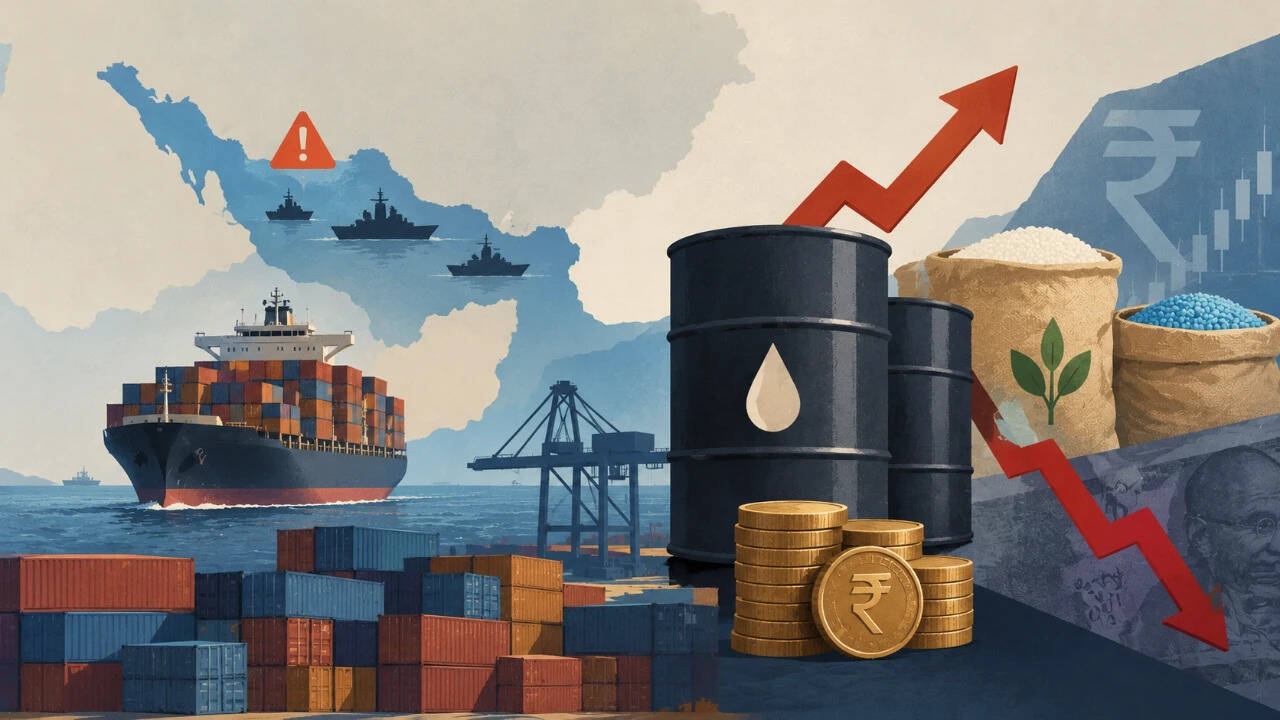
Govt has energy and fertiliser stocks ready, but higher oil and freight costs will strain the rupee, deficits and foreign investment. NEW DELHI: As war clouds gather over West Asia once again, govt seems better prepared with energy and fertiliser stocks, but higher oil prices will hurt the currency and deficit levels, apart from foreign portfolio investment, which is already under strain.Besides, the already-elevated freight rates — nearly 10 times the pre-war level on certain routes — will spike further as insurance premiums rise in an environment when finding vessels and crew to go into the Strait of Hormuz is often difficult. This will have an impact on exports as well as the entire supply chain when container shortages are seen in the eastern hemisphere, along with port congestion in certain parts of the world. On Oct 22, the Drewry World Container Index was at $4,585 for a 40-feet container, compared with $1,746 on Oct 25, 2025.“It is already pushing freight rates beyond a point. Right now, buyers are managing because they were short of inventory. Now, that they are stocked up, it is unclear if they can absorb higher freight. Fresh disruption in West Asia will have an adverse impact for rest of the world too,” said Ajai Sahay, director general at Fieo. He said container rates to West Asian ports have shot up from $800 to $8,000 to $10,000 now.“The East-West container freight market remains uncertain. Security risks and attacks on ships continue to affect vessel movements through the Gulf, with only two containerships sailing into the Gulf in Week 42, down from five the previous week. Meanwhile, sailings through the Suez Canal increased slightly, from 54 in Week 41 to 55 in Week 42,” Drewry said.There are also concerns over crew and vessels entering the Strait of Hormuz, which has emerged as the epicentre of the conflict. In any case, most businesses reckon that any uncertainty, especially a war that has implications on global energy supplies, is best avoided.Oil is the biggest concern with crude price for Indian refiners averaging $120 a barrel in Oct, the highest monthly average in 12 years. And, with petrol averaging $140 a barrel and diesel at over $154, the pressure on state-run retailers in mounting as they incur losses, given that pump prices are linked to the import price of the product.Although govt had shielded them through duty cuts and permission to raise prices subsequently, the Centre has limited headroom for fiscal concessions. Already, fuel and fertiliser subsidies are well past last year’s level and it will have to provide extra, if the need arises.For the moment, top officials said, fertiliser companies took advantage of a falling price window to stock up for the next season and the fertiliser ministry had some surplus cash with it due to the savings.There is some cushion for the Centre due to higher-than-budgeted disinvestment receipts and dividends from state-run financial institutions and RBI, with tax collections holding up so far, which is expected to keep the fiscal deficit within the target of 4.3% of GDP. But, a spike in the import bill due to higher commodity prices will have impact on the trade deficit and the current account deficit. And, a weaker rupee will make it less attractive for foreign funds to invest in Indian stocks.
Times of India·3 hours ago·3 min read
Business
Massive fire engulfs Shiv Market near Jammu Railway Station, 35-40 shops gutted
Massive fire broke out at Shiv Market, opposite Jammu Railway Station NEW DELHI: Around 35 to 40 shops were completely gutted after a massive fire broke out at Shiv Market, opposite Jammu Railway Station, in the early hours of Monday. No casualties or injuries have been reported so far, while fire and emergency services teams were working to bring the blaze under control. The cause of the fire remains unknown. BJP MLA Vikram Randhawa said the fire reportedly began due to a short circuit in one shop before spreading rapidly to adjoining establishments. Shiv Market is a major commercial hub with shops selling dry fruits and blankets, as well as eateries and dhabas.“The fire started with a short circuit in one shop and spread rapidly, engulfing surrounding shops. By the time the fire brigade arrived, the entire market had been consumed by the flames. In my estimation, about 35 to 40 shops have been completely gutted,” Randhawa said.Describing the firefighting efforts, the MLA said the blaze had engulfed the entire market by the time the situation could be brought under control. He added that police personnel and senior officers were actively involved in managing the situation.“As it kept growing, by the time the whole system came under control, it had already engulfed the entire market. Right now, our police are completely alert and actively controlling the situation. You can see that from the SHO to our SP, everyone is personally involved, even holding and dragging pipes all the way to the shops,” Randhawa said.A shopkeeper said at least 25 to 30 shops had suffered total losses and urged the administration to provide compensation to those affected. Join conversation View All Comments → Share your thoughts in the comments Insightful Agree Disagree Skeptical Concerning Promising Worth Reading Big Development Post Comment Be respectful · TOI community guidelines “The entire market has been reduced to ashes. At least 25 to 30 shops are a total loss. We pray to God to grant everyone the strength to cope with this — the loss is immense, a total loss. I also urge the administration to step in as quickly as possible and ensure that compensation is provided without delay,” the shopkeeper said. Randhawa said the full extent of the damage could be assessed only after the situation was completely under control. He said shopkeepers were cooperating with the administration, with the deputy commissioner, SP South, DSP, SHO and their teams present at the site. Members of civil society were also helping with relief efforts.On compensation for affected shopkeepers, Randhawa said the matter would be discussed with the administration later, describing the damage as massive.
Times of India·4 hours ago·2 min read
Business
Banks pass on rate hikes, but go slow when rates fall; RBI study finds
A recent study by the RBI indicates that banks are more responsive to interest rate hikes than to cuts. Specifically, banks relayed 76.4% of repo rate increases, while only 64% of reductions were passed on. Amid periods of tightening, lending rates surged significantly, in contrast to the minimal decreases observed during easing. This research highlights the intricate dynamics of interest rate adjustments, particularly affecting sectors like MSMEs.
Times of India·5 hours ago·2 min read