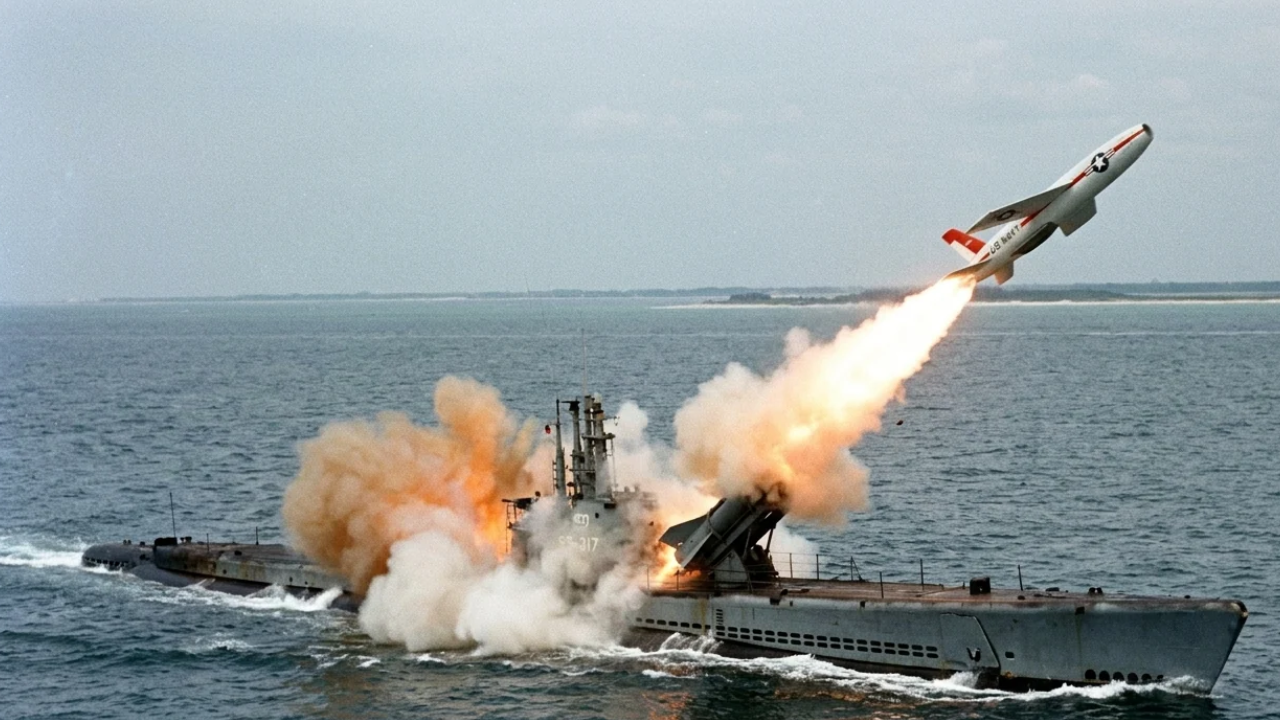
PC: AI Generated On a June morning in 1959, a US Navy submarine became an unusual starting point for a postal delivery. Instead of loading its mail onto an aircraft or a conventional transport vehicle, the Navy placed thousands of letters inside a guided missile and launched it towards Florida. The journey took just 22 minutes as reported by Smithsonian National Postal Museum. The operation involved the USS Barbero, a Regulus I cruise missile and 3,000 pieces of mail intended for delivery at a naval air station near Jacksonville. It was presented as a demonstration of how military technology might serve a civilian purpose. Yet the experiment, despite attracting considerable attention, never developed into a regular method of transporting mail. How a US Navy submarine launched a missile carrying 3,000 letters The vessel chosen for the operation was the USS Barbero, a US Navy submarine equipped to launch Regulus I guided missiles. During the Cold War, the Navy had been developing submarine-based missile systems as part of its wider military strategy. The Regulus was designed to travel considerable distances under guidance, carrying a nuclear warhead if required. For the 1959 demonstration, however, its payload was rather different. Two specially prepared metal containers were fitted into the missile before launch. They held a combined total of 3,000 letters. Their red and blue paintwork reflected the colours commonly associated with American postal boxes, while the words "US Mail" identified their intended purpose.The containers occupied the section of the missile normally reserved for its nuclear payload. It was a temporary change to the missile's usual configuration, allowing the Navy to demonstrate a non-military application of the same delivery system.The operation also involved Arthur Summerfield, who was serving as the US Postmaster General. The 22-minute missile flight that delivered 3,000 letters to Florida The launch took place on June 8, 1959. Shortly before noon, the Regulus I was fired from the USS Barbero and sent towards the Naval Auxiliary Air Station at Mayport, Florida, close to Jacksonville. The distance between the submarine and its destination was approximately 100 miles. The missile completed the journey in 22 minutes before reaching the designated naval facility.For a postal experiment, the delivery method was far removed from the established network of trucks, trains, ships and aircraft used by the US Postal Service. The letters had travelled inside a weapon originally developed for military operations, guided towards a predetermined destination by sophisticated navigation equipment.The flight demonstrated that a missile could carry a relatively small payload over a considerable distance and reach a specified location with precision. The 1959 vision of sending international letters aboard guided missiles Summerfield viewed the demonstration as an opportunity to explore faster ways of moving correspondence across long distances. At the time, the development of guided missiles was progressing alongside wider advances in aviation, communications and space technology. He believed that the accuracy and speed of these systems could eventually have applications in civilian postal transportation. The Florida flight gave him an occasion to discuss that possibility publicly.Following the successful delivery, Summerfield described the operation as the first official use of a guided missile to carry mail by a national postal department. He also made a prediction about how the technology might develop. He suggested that, before humans reached the Moon, guided missiles could be transporting letters between New York and California, as well as to destinations such as Britain, India and Australia, with journeys taking only a few hours. The Cold War technology behind the delivery The Regulus I was developed as a guided cruise missile for the US Navy. Its purpose was to give submarines the ability to launch a nuclear-capable weapon towards targets hundreds of miles away. Its guidance system was designed to direct the missile along a planned course. The 1959 postal flight used that capability on a much shorter journey, covering roughly 100 miles between the submarine and Mayport.The choice of a missile was significant in the context of the Cold War. Both the United States and the Soviet Union were investing heavily in military technology, including long-range weapons and delivery systems. Demonstrating the accuracy of American missile technology also carried a wider strategic message. The mail operation therefore had two dimensions. Publicly, it was presented as an experiment in transporting correspondence. At the same time, it provided a demonstration of the Navy's ability to guide a missile towards a specific destination. Why missile mail never became a postal service Despite the successful flight and Summerfield's predictions, the experiment was not repeated as an American postal operation. The June 1959 launch remained the only known instance of the US Postal Service using a guided missile to transport mail. The demonstration established that letters could be carried from a submarine to a designated location using missile technology. It did not establish that the method could compete with existing postal transportation systems.A regular service would have required specialised equipment, launch facilities, carefully planned routes and substantial coordination between military and postal authorities. The cost and practical demands of using military missiles for routine correspondence also raised questions about whether such a system would offer meaningful advantages.Its place in postal history is preserved through objects associated with the flight. The Smithsonian National Postal Museum holds a Regulus I missile mail container from the demonstration, documenting the unusual attempt to combine military technology with civilian mail delivery. The day a submarine became a post office The USS Barbero's 1959 mission lasted only 22 minutes, but it created one of the more unusual episodes in American postal history. Three thousand letters travelled inside a guided missile, launched from beneath the surface of the sea and delivered to a naval facility in Florida.The experiment took place at a time when military and technological developments were prompting new ideas about long-distance transportation. Summerfield's vision of missile-powered mail never materialised, and conventional postal networks continued to handle the movement of letters.
In 1959, US Navy mailed 3,000 letters by missile in just 22 minutes
PC: AI Generated On a June morning in 1959, a US Navy submarine became an unusual starting point for a postal delivery. Instead of loading its mail onto an aircraft or a conventional transport vehicle, the Navy placed thousands of letters inside a guided missile and launched it towards Florida. The journey took just 22 minutes as reported by Smithsonian National Postal Museum. The operation involved the USS Barbero, a Regulus I cruise missile and 3,000 pieces of mail intended for delivery at a naval air station near Jacksonville. It was presented as a demonstration of how military technology might serve a civilian purpose. Yet the experiment, despite attracting considerable attention, never developed into a regular method of transporting mail. How a US Navy submarine launched a missile carrying 3,000 letters The vessel chosen for the operation was the USS Barbero, a US Navy submarine equipped to launch Regulus I guided missiles. During the Cold War, the Navy had been developing submarine-based missile systems as part of its wider military strategy. The Regulus was designed to travel considerable distances under guidance, carrying a nuclear warhead if required. For the 1959 demonstration, however, its payload was rather different. Two specially prepared metal containers were fitted into the missile before launch. They held a combined total of 3,000 letters. Their red and blue paintwork reflected the colours commonly associated with American postal boxes, while the words "US Mail" identified their intended purpose.The containers occupied the section of the missile normally reserved for its nuclear payload. It was a temporary change to the missile's usual configuration, allowing the Navy to demonstrate a non-military application of the same delivery system.The operation also involved Arthur Summerfield, who was serving as the US Postmaster General. The 22-minute missile flight that delivered 3,000 letters to Florida The launch took place on June 8, 1959. Shortly before noon, the Regulus I was fired from the USS Barbero and sent towards the Naval Auxiliary Air Station at Mayport, Florida, close to Jacksonville. The distance between the submarine and its destination was approximately 100 miles. The missile completed the journey in 22 minutes before reaching the designated naval facility.For a postal experiment, the delivery method was far removed from the established network of trucks, trains, ships and aircraft used by the US Postal Service. The letters had travelled inside a weapon originally developed for military operations, guided towards a predetermined destination by sophisticated navigation equipment.The flight demonstrated that a missile could carry a relatively small payload over a considerable distance and reach a specified location with precision. The 1959 vision of sending international letters aboard guided missiles Summerfield viewed the demonstration as an opportunity to explore faster ways of moving correspondence across long distances. At the time, the development of guided missiles was progressing alongside wider advances in aviation, communications and space technology. He believed that the accuracy and speed of these systems could eventually have applications in civilian postal transportation. The Florida flight gave him an occasion to discuss that possibility publicly.Following the successful delivery, Summerfield described the operation as the first official use of a guided missile to carry mail by a national postal department. He also made a prediction about how the technology might develop. He suggested that, before humans reached the Moon, guided missiles could be transporting letters between New York and California, as well as to destinations such as Britain, India and Australia, with journeys taking only a few hours. The Cold War technology behind the delivery The Regulus I was developed as a guided cruise missile for the US Navy. Its purpose was to give submarines the ability to launch a nuclear-capable weapon towards targets hundreds of miles away. Its guidance system was designed to direct the missile along a planned course. The 1959 postal flight used that capability on a much shorter journey, covering roughly 100 miles between the submarine and Mayport.The choice of a missile was significant in the context of the Cold War. Both the United States and the Soviet Union were investing heavily in military technology, including long-range weapons and delivery systems. Demonstrating the accuracy of American missile technology also carried a wider strategic message. The mail operation therefore had two dimensions. Publicly, it was presented as an experiment in transporting correspondence. At the same time, it provided a demonstration of the Navy's ability to guide a missile towards a specific destination. Why missile mail never became a postal service Despite the successful flight and Summerfield's predictions, the experiment was not repeated as an American postal operation. The June 1959 launch remained the only known instance of the US Postal Service using a guided missile to transport mail. The demonstration established that letters could be carried from a submarine to a designated location using missile technology. It did not establish that the method could compete with existing postal transportation systems.A regular service would have required specialised equipment, launch facilities, carefully planned routes and substantial coordination between military and postal authorities. The cost and practical demands of using military missiles for routine correspondence also raised questions about whether such a system would offer meaningful advantages.Its place in postal history is preserved through objects associated with the flight. The Smithsonian National Postal Museum holds a Regulus I missile mail container from the demonstration, documenting the unusual attempt to combine military technology with civilian mail delivery. The day a submarine became a post office The USS Barbero's 1959 mission lasted only 22 minutes, but it created one of the more unusual episodes in American postal history. Three thousand letters travelled inside a guided missile, launched from beneath the surface of the sea and delivered to a naval facility in Florida.The experiment took place at a time when military and technological developments were prompting new ideas about long-distance transportation. Summerfield's vision of missile-powered mail never materialised, and conventional postal networks continued to handle the movement of letters.
Read the full story at Times of India.