Iran war news LIVE updates: Iranian President Masoud Pezeshkian on Saturday (local time) said that Tehran has adopted a 'new arrangement' to tackle what he described as special conditions, as the US intensifies its economic pressure and sanctions targeting the country's financial and commercial networks. In a post on X, Pezeshkian accused its adversaries, particularly the US, of trying to cut off the Islamic Republic's crucial economic lifelines to pressure its people. He further noted that despite the mounting pressure, public support and government measures had prevented those objectives from being achieved.
Houthis target oil facility near Riyadh as Kingdom hits Sanaa, group confirms
Iran-backed Yemen's Houthis claimed responsibility for an attack on an oil facility near the Saudi capital on Saturday and accused the Kingdom of striking the Yemeni capital several times. The two sides have traded strikes since the Houthis seized Yemen's Red Sea coast and took control of the Bab al-Mandab Strait in a lightning offensive last month. Houthi-affiliated channel Al-Masirah TV reported that "Saudi enemy aircraft" hit Sanaa with 26 strikes, after earlier reporting "Saudi aggression" against the Yemeni capital, without providing details on the targets or casualties. While Saudi authorities are yet to comment, late on Saturday, Houthi military spokesman Yahya Saree said the group had targeted an oil facility in Riyadh with ballistic missiles and drones, adding that they had sparked fires at the targeted sites.
As Trump boosts military presence, pressure builds on Iran
Iran has started to feel the pressure of the US war as US President Donald Trump boosts the US military presence in the region. According to a Bloomberg report, inflation in Tehran is around 90 per cent, with oil flows through the Strait of Hormuz recovering despite continued Iranian attacks. Additionally, Trump is sending another aircraft carrier with 10,000 sailors and Marines to the region. Iran’s economic situation is extremely painful, but the country is adapting, according to one Tehran official, who asked not to be identified so they could speak candidly. The Islamic Republic is preparing for a fresh US bombing campaign, potentially greater than before, but can respond.
Flights between Iran and Iraq's Najaf to resume on Sunday
Iraq's Najaf International Airport will resume flights to and from Iran from Sunday, with three evening flights scheduled, Iraq's state news agency cited the airport as saying on Saturday. Iraq said on Friday that a US waiver would allow Iranian airlines to operate up to 40 daily flights to and from Najaf, excluding Mahan Air.
Stay tuned to this LIVE blog for the latest updates on the Iran war
Huge billboards on the walls of Tehran mocking US President Donald Trump and depicting American drones under the boot of an Iranian soldier are providing a chronicle of Iran's war with the United States and Israel.
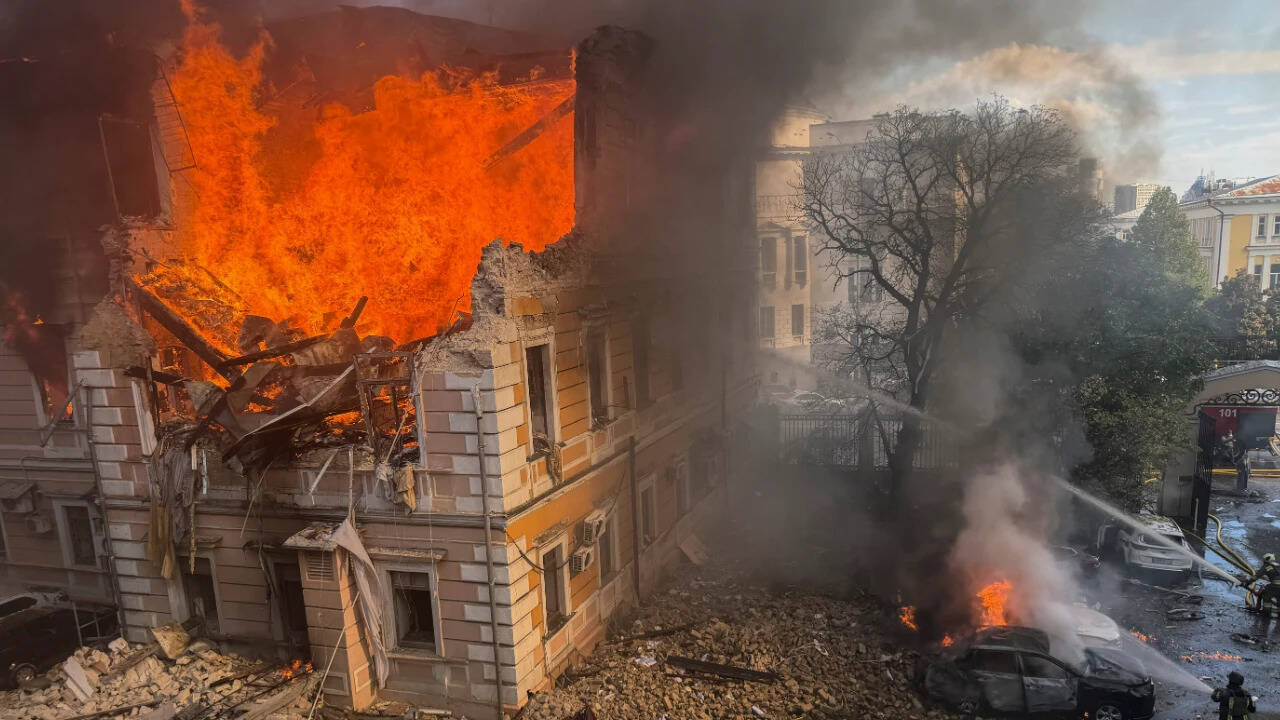
A hospital in Gaza says Israeli strikes have killed five people, including two from the Palestinian territory's Christian minority. And a fire broke out at an oil facility in the Saudi capital, with no details released on the cause.
Iran has started to feel the pressure of the US war as US President Donald Trump boosts the US military presence in the region. According to a Bloomberg report, inflation in Tehran is around 90 per cent, with oil flows through the Strait of Hormuz recovering despite continued Iranian attacks. Additionally, Trump is sending another aircraft carrier with 10,000 sailors and Marines to the region.
Iran-backed Yemen's Houthis claimed responsibility for an attack on an oil facility near the Saudi capital on Saturday and accused the Kingdom of striking the Yemeni capital several times. The two sides have traded strikes since the Houthis seized Yemen's Red Sea coast and took control of the Bab al-Mandab Strait in a lightning offensive last month.
Iranian President Masoud Pezeshkian on Saturday (local time) said that Tehran has adopted a 'new arrangement' to tackle what he described as special conditions, as the US intensifies its economic pressure and sanctions targeting the country's financial and commercial networks.
Swati Gandhi is a digital journalist with over four years of experience, specialising in international and geopolitical issues. Her work focuses on foreign policy, global power shifts, and the political and economic forces shaping international relations, with a particular emphasis on how global developments affect India. She approaches journalism with a strong belief in context-driven reporting, aiming to break down complex global events into clear, accessible narratives for a wide readership.<br><br> Previously, Swati has worked at Business Standard, where she covered a range of beats including national affairs, politics, and business. This diverse newsroom experience helped her build a strong grounding in reporting, while also strengthening her ability to work across both breaking news and in-depth explanatory stories. Covering multiple beats early in her career has helped her be informed about her current work, allowing her to connect domestic developments with wider international trends.<br><br> At Live Mint, she focuses on international and geopolitical issues through a business and economic lens, examining how global political developments, foreign policy decisions, and power shifts impact markets, industries, and India’s strategic and economic interests.<br><br> She holds a Bachelor’s degree in English (Honours) from the University of Delhi and a Master’s degree in Journalism and Mass Communication from Guru Gobind Singh Indraprastha University. Her academic training has shaped her emphasis on precision, analytical rigour, and clarity in writing. Her interests include global political economy and the intersection of geopolitics with business.<br><br> Outside work, Swati focuses on exploring her passion and love for food. From fancy cafes to street spots, Swati explores food like a true foodie.
Stay updated with the latest Trending, India, World and US news.