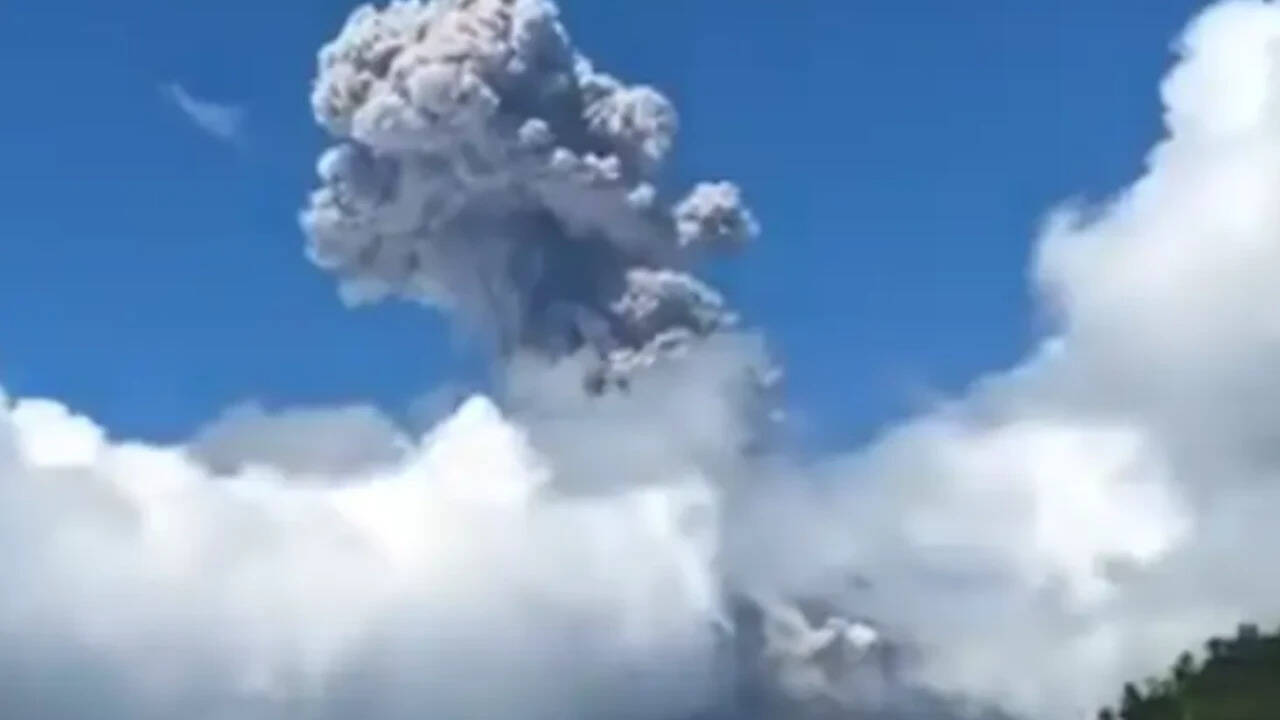
Volcanic activity and earthquakes are common in the Philippines A nearly six-minute explosive eruption at the Philippines’ Mount Mayon sent an ash column soaring 3,000 metres into the sky on Friday, prompting authorities to raise the volcano’s alert level and order evacuations near its crater.The Philippine Institute of Volcanology and Seismology (PHIVOLCS) raised the alert level from 2 to 3 on its five-level scale and urged residents within a six-kilometre radius of the crater to evacuate. The ash column gradually drifted southwest towards nearby population centres. There were no immediate reports of casualties or damage.In its bulletin, the institute said Mayon had entered a new phase of magmatic eruption, increasing the possibility of lava flows and hazardous pyroclastic density currents (PDCs) along the upper and middle slopes of the volcano in the coming days and weeks.Authorities warned residents of the dangers posed by pyroclastic flows, lava, rockfalls and other volcanic hazards. Aircraft were also advised to avoid flying close to the volcano. Mayon among Philippines' most active volcanoesStanding at 2,462 metres, Mount Mayon is located about 330 km southeast of Manila and is known for its near-perfect cone. It is among three volcanoes in the Philippines that have shown elevated activity this year, although no major eruptions had been reported. The volcano has a history of forcing large-scale evacuations. In June 2023, more than 12,000 people living along its lower slopes were moved to evacuation centres amid concerns over ash emissions and toxic gases from its crater.Volcanic activity and earthquakes are common in the Philippines, which lies along the Pacific Ring of Fire, a region marked by the movement and collision of tectonic plates.The country's most powerful eruption in recent decades was that of Mount Pinatubo in 1991. The eruption killed more than 800 people and sent an ash cloud thousands of kilometres across the region.
Watch: Philippines volcano erupts for nearly 6 minutes, spews ash 3 km high
Volcanic activity and earthquakes are common in the Philippines A nearly six-minute explosive eruption at the Philippines’ Mount Mayon sent an ash column soaring 3,000 metres into the sky on Friday, prompting authorities to raise the volcano’s alert level and order evacuations near its crater.The Philippine Institute of Volcanology and Seismology (PHIVOLCS) raised the alert level from 2 to 3 on its five-level scale and urged residents within a six-kilometre radius of the crater to evacuate. The ash column gradually drifted southwest towards nearby population centres. There were no immediate reports of casualties or damage.In its bulletin, the institute said Mayon had entered a new phase of magmatic eruption, increasing the possibility of lava flows and hazardous pyroclastic density currents (PDCs) along the upper and middle slopes of the volcano in the coming days and weeks.Authorities warned residents of the dangers posed by pyroclastic flows, lava, rockfalls and other volcanic hazards. Aircraft were also advised to avoid flying close to the volcano. Mayon among Philippines' most active volcanoesStanding at 2,462 metres, Mount Mayon is located about 330 km southeast of Manila and is known for its near-perfect cone. It is among three volcanoes in the Philippines that have shown elevated activity this year, although no major eruptions had been reported. The volcano has a history of forcing large-scale evacuations. In June 2023, more than 12,000 people living along its lower slopes were moved to evacuation centres amid concerns over ash emissions and toxic gases from its crater.Volcanic activity and earthquakes are common in the Philippines, which lies along the Pacific Ring of Fire, a region marked by the movement and collision of tectonic plates.The country's most powerful eruption in recent decades was that of Mount Pinatubo in 1991. The eruption killed more than 800 people and sent an ash cloud thousands of kilometres across the region.
Read the full story at Times of India.