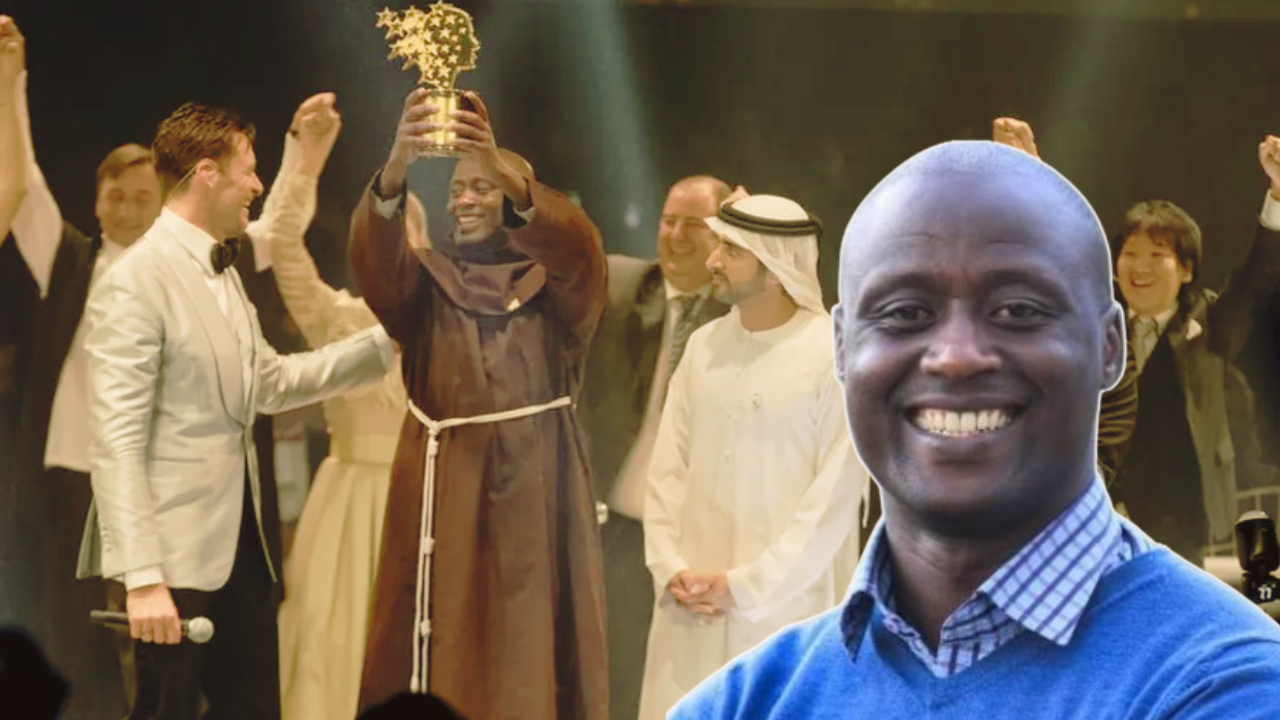
Tabichi taught mathematics and physics at Keriko Mixed Day Secondary School in Pwani Village, in Kenya. A science teacher in rural Kenya was giving away most of his monthly income to help poor families and students. At the same time, he was teaching in a school with one computer, poor internet access and limited facilities. His students, however, were competing against some of the country's better-equipped schools in science competitions. In 2019, that teacher, Peter Tabichi, was named the winner of the $1 million Global Teacher Prize, becoming the first African winner of the award.Tabichi taught mathematics and physics at Keriko Mixed Day Secondary School in Pwani Village, in Kenya's Rift Valley. The school was in a remote, semi-arid area where drought and food insecurity were recurring problems. According to the official website of the Global Teacher Prize, about 95% of the students came from poor families, while almost a third were orphans or had only one parent. He gave away 80% of his income According to the official website of the Global Teacher Prize, Tabichi was a member of the Franciscan religious order and donated 80% of his monthly income to help poor people in his community. He used his income to support people facing financial difficulties, while he also spent additional time helping students who were struggling academically. He and four other teachers provided one-to-one tuition in mathematics and science outside regular school hours, including on weekends. Speaking to The National after winning the award, Tabichi said he had been donating 80% of his salary since joining the Franciscan order. “They come from very poor families, even affording breakfast is hard. When they are in school they are not able to concentrate mainly because they are not able to get enough meals at home,” Tabichi said. The school had one computer He used his income to support people facing financial difficulties, while he also spent additional time helping students who were struggling academically. As reported by The Global Teacher Prize, Keriko Mixed Day Secondary School did not have the facilities available in many better-resourced schools. The school had just one computer, poor internet connectivity and a student-teacher ratio of 58:1. Students also had to walk several kilometres to reach the school. Yet Tabichi incorporated technology into his teaching wherever he could. The Global Teacher Prize said he used ICT in about 80% of his lessons, sometimes visiting internet cafés and saving online material so it could be used offline in class. Tabichi himself believed that limited resources could make creativity more important, rather than less. “Creativity is very important, especially in challenging situations and resource constrained environments,” he told The National. “To be a great teacher, you have to be creative and use technology, you really have to promote those modern ways of teaching. You have to do more and talk less.” His students started winning science competitions One of Tabichi's biggest achievements was helping students discover an interest in science and turn it into practical projects. He expanded the school's Science Club and helped students develop research projects. According to the Global Teacher Prize, around 60% of the students involved in the programme qualified for national competitions. In the 2018 Kenya Science and Engineering Fair, his students presented a device designed to help blind and deaf people measure objects. The school went on to finish first nationally in the public schools category. Another student team developed a project using local plants to generate electricity and received recognition from the Royal Society of Chemistry. "I am only here because of what my students have achieved” The award was presented at a ceremony in Dubai hosted by actor Hugh Jackman. Tabichi's work eventually took him far beyond his school in rural Kenya. In March 2019, he was announced as the winner of the Global Teacher Prize, selected from around 10,000 applicants from 179 countries, according to The Guardian. The award was presented at a ceremony in Dubai hosted by actor Hugh Jackman. Tabichi became the first African winner of the prize. But in his acceptance speech, Tabichi shifted the attention away from himself. “I am only here because of what my students have achieved. This prize gives them a chance. It tells the world that they can do anything,” he said. He also said: “Every day in Africa we turn a new page and a new chapter ... This prize does not recognise me but recognises this great continent's young people.” The award also came with $1 million in prize money. He wanted the prize money to help his community Tabichi said he wanted to use the prize money to improve the facilities available to his students and help his wider community. Speaking to The National, he said he wanted to build a modern school laboratory and develop projects that could help people deal with food insecurity, including kitchen gardening and drought-resistant crops. For Tabichi, the prize was therefore not simply recognition for his own work. He saw it as an opportunity for his students and community. “I know this is the beginning of a new life not just for me but for Kenya and Africa,” he told The National after receiving the award. He also summed up his approach to teaching in simple terms: “Seeing my learners grow in knowledge, skills and confidence is my greatest joy in teaching!” the Global Teacher Prize quoted him as saying. Where is Peter Tabichi now? Peter Tabichi is now working full-time with the Peter Tabichi Foundation. Peter Tabichi is now working full-time with the Peter Tabichi Foundation, where he serves as its founder and programme lead. The foundation works with teachers across Kenya to develop practical, inclusive and curriculum-aligned teaching resources and build professional learning communities. According to the Global Teacher Prize, Tabichi completed a Master of Arts in Education and International Development from University College London, which he pursued part-time while continuing his work as a teacher and contributing to education reform in Kenya.
Teacher who gave away 80% of income won $1 million global prize
Peter Tabichi, a remarkable science educator from rural Kenya, clinched the Global Teacher Prize in 2019, earning $1 million for his dedication to his students. Committed to changing lives, he donated 80% of his earnings to uplift impoverished families. Through his perseverance, students from his school triumphed in science competitions, gaining national acknowledgment. The funds are set to bolster educational facilities and combat local food insecurity.
Read the full story at Times of India.
